
Picking a niche is the first big decision in affiliate marketing, and it’s the one that makes beginners freeze. Choose too broad and you disappear among thousands of bigger sites. Choose too narrow and you run out of things to say. Choose something you don’t care about and you’ll likely quit in a few months.
The good news is that you don’t need a perfect answer. You need a reasonable one, based on a few honest checks. This guide walks you through what a niche is, why it matters, and a simple process for choosing an affiliate marketing niche you can stick with.

What Is an Affiliate Marketing Niche?
A niche is the specific topic or audience you focus on. Instead of trying to help everyone with everything, you pick one area and become genuinely useful in it.
Think of it as a set of layers. “Health” is a broad category. “Home fitness” is narrower. “Home workouts for busy parents” is a niche, because it names a topic and the people it serves.
Your niche decides who reads your content, which problems you solve, and which kinds of products you’ll eventually be able to recommend. That’s why it’s worth taking your time here.
Why Choosing the Right Niche Matters
- It builds trust. Readers trust someone who clearly understands their situation more than a site that covers a bit of everything.
- It makes your content easier to plan. When your topic is clear, you always know what to write or create next.
- It helps with search visibility. Search engines look for helpful, focused content from sources that show real knowledge of a subject. A site that stays on topic gives them a clearer signal.
- It keeps your recommendations relevant. Affiliate recommendations work best when they genuinely fit the audience and the problem they’re trying to solve.
- It keeps you going. Affiliate marketing takes time. Interest in the topic is often what carries people through the slow early months.
Passion, Demand, and Ability: Finding the Overlap
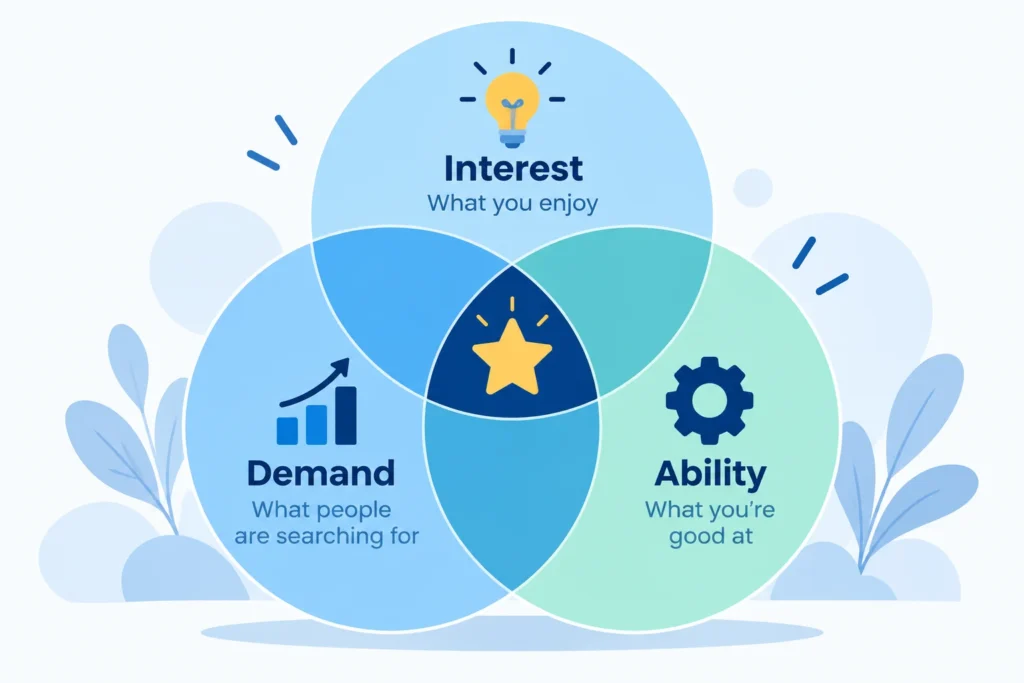
You’ll often hear advice to “follow your passion.” Passion helps, but it isn’t enough on its own. A topic you love that nobody searches for or buys products in will be hard to build on. On the other hand, a topic that looks profitable but bores you will be hard to keep up.
A better approach is to look for the overlap between three things:
- Interest: A topic you can stay curious about for a long time.
- Demand: People are already searching for help, answers, or products in this area.
- Ability: You have some knowledge or experience, or you’re willing to learn honestly and share what you learn.
How to Choose an Affiliate Marketing Niche: 6 Simple Steps
Step 1: List your interests, skills, and experience
Start with yourself. Write down topics you enjoy, things you’ve learned the hard way, problems you’ve solved, and subjects friends ask you about. Include your job, hobbies, and life experience. You don’t need to be an expert, but a head start makes your content more genuine.
Step 2: Look for real problems people want solved
Good niches usually revolve around a problem or a goal. People want to save money, learn a skill, improve their health, organize their home, or make better buying decisions. For each topic on your list, ask: what are people struggling with here, and what would they pay to make easier?
Step 3: Check that people are searching for it
Before you commit, look at what people actually search for. Start with free options. Type your topic into Google and look at the autocomplete suggestions and the “People also ask” box. Check whether interest is steady, growing, or fading using Google Trends. If you use a keyword research tool, look for many related questions rather than one big keyword.
You’re looking for a topic that gives you plenty of content ideas, not one or two.
Step 4: Check that products or services exist in this niche
Affiliate marketing only works if there are genuine products or services to recommend. Ask yourself whether people in this niche buy things, whether companies in the space offer affiliate programs, and whether you could honestly recommend what they sell. You don’t need to commit to anything yet. You’re only confirming the opportunity exists.
Step 5: Look at the competition
Competition isn’t automatically bad. It often means there’s demand. But if every top result is a huge, well-known site, a very broad topic will be hard to break into.
This is where narrowing down helps. Instead of “personal finance,” consider “budgeting for freelancers.” Instead of “fitness,” consider “strength training for beginners over 40.” A smaller, more specific audience is easier to serve well and easier to stand out in.
Step 6: Test it before you commit
Try writing or creating five to ten content ideas for your chosen niche. If the ideas come easily and you feel interested in making them, that’s a good sign. If you struggle after three or four, the topic may be too narrow or not a good fit for you. It’s much cheaper to find that out now than after you’ve built a whole site.
A Quick Example of Narrowing Down
Say you enjoy cooking. “Cooking” is far too broad. You might narrow it down like this:
- Broad topic: cooking
- Narrower: healthy meal prep
- Niche: meal prep for busy working parents
Now you have a clear audience, a clear set of problems (time, budget, getting kids to eat), and plenty of content ideas. That’s what a workable niche looks like.
Be Careful With Sensitive Topics
Some niches, such as health, medical advice, and personal finance, can seriously affect people’s wellbeing or money. Google holds this kind of content to a higher standard and looks for real expertise, experience, and trustworthiness.
You can still work in these areas, but be honest about your background, avoid exaggerated claims, and never present yourself as a professional you’re not. If you’re unsure, choose a narrower, lower-risk angle within the topic, such as sharing your own experience rather than giving advice that needs a license.
Common Niche Mistakes to Avoid
- Choosing a niche only because it seems profitable
- Going too broad and trying to cover everything
- Going so narrow that you quickly run out of topics
- Picking a topic you have no interest in
- Copying what someone else is doing without checking if it fits you
- Never testing the idea before building around it
- Switching niches every few weeks
Remember that no niche guarantees income. Results depend on your content, your audience, and your consistency over time.
Can You Change Your Niche Later?
Yes. Many people refine or shift their niche after a few months once they learn what their audience responds to. Treat your first choice as a starting point, not a life sentence. Just give it enough time, usually several months of consistent work, before deciding it isn’t working.
Your Next Steps
Once you’ve picked a niche you’re comfortable with, you can move on to the next stage of the roadmap:
- If you’re new to the basics, read our beginner’s guide to what affiliate marketing is.
- Follow the full beginner roadmap on our Start Here page.
- Download the free Affiliate Success Blueprint, which includes a section on choosing a niche without relying only on passion.
Frequently Asked Questions
What is a niche in affiliate marketing?
It’s the specific topic or audience you focus on, such as home workouts for busy parents, instead of a broad subject like health.
What is the best niche for affiliate marketing beginners?
There’s no single best niche. The best one for you is a topic you can stay interested in, where people are already searching for help, and where real products or services exist to recommend.
Should I choose a broad or narrow niche?
Most beginners do better with a narrower niche because it’s easier to stand out and easier to serve one audience well. You can always expand later.
Can I have more than one niche?
You can, but it’s harder to build trust and visibility when you split your attention. It’s usually better to start with one and expand once it’s working.
How do I know if a niche is profitable?
Look for steady search interest, products people actually buy, and affiliate programs that offer fair terms. Keep in mind that profit also depends on your content and consistency, and nothing is guaranteed.
Do I need to be an expert?
Not always, but you do need to be honest. You can share what you’re learning and your real experience. For topics like health or finance, be extra careful about what you claim.
How long should I stick with a niche before changing it?
Give it several months of consistent effort so you have real feedback before making a decision.
Final Thoughts
Choosing an affiliate marketing niche doesn’t have to be stressful. Start with what interests you, check that people want help in that area, make sure real products exist, and narrow it down until you can describe your audience in one sentence. Then test it, learn from what happens, and adjust as you go.
Affiliate disclosure: AffiliateForSuccess may earn a commission when you buy through links on this site, at no extra cost to you. We aim to give honest recommendations so you can make your own informed decisions.