
There are thousands of affiliate programs out there, and most of them look appealing on the surface. Big commission numbers, polished sales pages, and promises of easy income can make almost any program seem like a good idea.
The truth is that the program you choose has a big effect on your results and, just as importantly, on your reputation. This guide gives you a practical checklist for how to choose an affiliate program, so you can judge offers for yourself instead of being guided by hype.
Why Your Choice of Program Matters
When you recommend a product, your audience trusts your judgment. If the product disappoints them, the damage lands on you, not just the company. A poor program can also cause practical problems, such as unclear tracking, late payments, or rules that quietly limit how you can promote.
Choosing carefully at the start saves you time, protects your credibility, and makes the whole process easier to stick with.
Where to Find Affiliate Programs
Before you can evaluate programs, you need to find them. Common places to look include:
- Companies you already use and trust. Check their website footer for links labeled Affiliates, Partners, or Referral Program.
- Affiliate networks. These platforms list programs from many merchants in one place and handle tracking and payments.
- Your niche research. Look at the products and services people in your niche already buy, then check whether those companies have a program.
If you haven’t picked a topic yet, start with our guide to choosing an affiliate marketing niche [add internal link]. Your niche makes it much easier to know which programs actually fit.
The Beginner’s Checklist: 8 Things to Check
1. Product quality
Start with the product itself. Does it solve a real problem? Would you use it, or recommend it to someone you know? If you can try it, read the reviews, or look at how it works, do that before promoting it. A lower commission on a product you believe in is usually a better bet than a high one on something you doubt.
2. Company reputation
Look for signs that the company is real and trustworthy: clear contact details, visible customer support, a proper refund policy, and genuine customer feedback. Search the company name along with words like “reviews” or “complaints” and read what people say, keeping in mind that any company will have a few unhappy customers.
3. Commission structure
Understand exactly how you earn. Is it a percentage or a fixed amount? Is it pay per sale, per lead, or per click? Does the program pay recurring commissions on subscriptions? A high rate on a one-time purchase can earn less over time than a modest recurring one, so think about the whole picture. If you need a refresher on the models, see our beginner’s guide to affiliate marketing [add internal link].
4. Cookie duration
The cookie window is how long after someone clicks your link a purchase is still credited to you. Some programs give a day, others give weeks or months. A longer window gives you more chance to be credited when buyers take their time to decide.
5. Payout terms
Check the minimum payout amount, how often payments are made, and which payment methods are available. Also look for how refunds are handled, since commissions on refunded sales are often reversed. Clear terms here are a good sign of a well-run program.
6. Tracking and reporting
A good program gives you a dashboard where you can see clicks, sales, and earnings. Without visibility, you can’t learn what’s working. If a program can’t show you your own results, think twice.
7. Support and promotional resources
Many programs provide ready-made landing pages, email swipes, banners, and training. For a beginner, these can make starting much easier, as we covered in our guide to affiliate marketing tools and setup [add internal link]. Also check whether someone is available to answer your questions.
8. Rules and restrictions
Read the program’s terms carefully. Many programs set rules about paid advertising, email promotion, use of their brand name, and how you describe their product. Breaking these rules, even by accident, can lead to lost commissions or a closed account.
Quick Reference: Good Signs and Warning Signs
Use this table when you’re comparing programs side by side.
| What to check | Good sign | Warning sign |
| Product quality | Solves a real problem and you would use or recommend it | Hard to explain what it actually does |
| Company reputation | Clear company details, real customer feedback, support contact | No company information, mostly hype or complaints |
| Commission | Clearly stated rate or amount, and recurring if it’s a subscription | Vague or hidden, or changes without notice |
| Cookie window | Stated clearly in the terms | Not mentioned, or extremely short |
| Payout terms | Clear minimum, schedule, and payment methods | Unclear when or how you get paid |
| Tracking and reports | A dashboard showing clicks and sales | No way to see your results |
| Promotional rules | Clear dos and don’ts for ads, email, and social | No rules, or rules you can’t find |
| Where income comes from | Mainly from product sales to customers | Mainly from recruiting other people |
Red Flags to Watch For
- Promises of guaranteed income or “no work required”
- Pressure to pay a large upfront fee before you can promote anything
- Income that depends mostly on recruiting other people rather than selling a real product
- Commission rates or terms that are vague, hidden, or change without notice
- No visible company information or customer support
- A product that is hard to explain or that you wouldn’t use yourself
- Heavy use of fake urgency, such as countdown timers that never end
If something feels off, trust that instinct. There are plenty of legitimate programs, so you never need to settle for a questionable one.
Should You Pay to Join an Affiliate Program?
Most legitimate affiliate programs are free to join. Some products have you buy or use the product first, which can make sense if you plan to recommend it honestly. Be cautious when a program requires a large payment just for permission to promote, especially if the pitch focuses more on what you could earn than on what the product does for customers.
Whatever you decide, read the refund policy and terms first, and never spend money you can’t afford to lose.
A Simple Way to Compare Two Programs
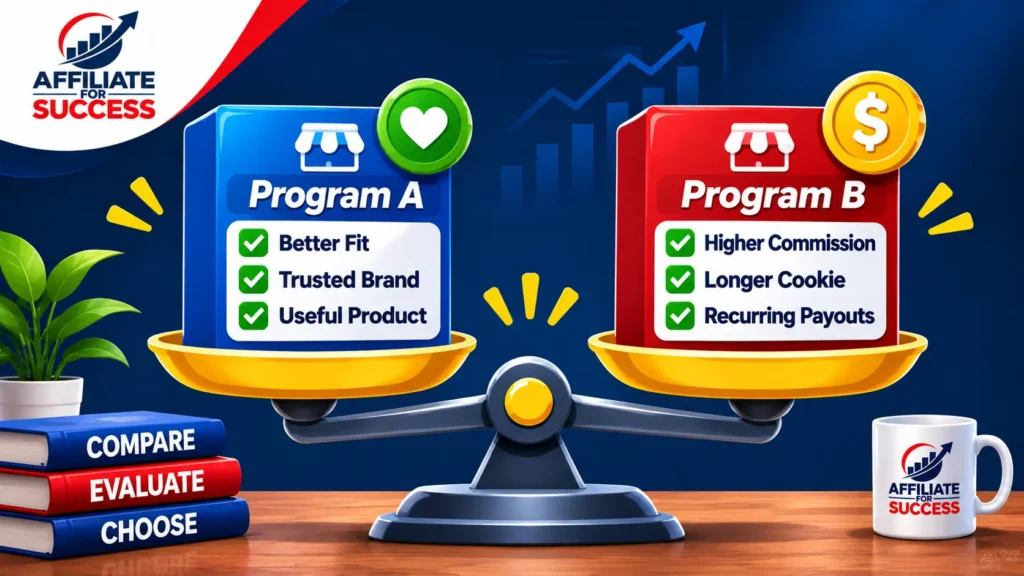
Say you’re deciding between two programs in the same niche. Run each through the checklist and score it honestly from 1 to 5 on product quality, company reputation, terms, and support. Add a note on whether you’d recommend it to a friend. The one you’d happily recommend, with fair and clear terms, is usually the right starting point, even if its commission is lower.
Start Small and Stay Honest
You don’t need to join ten programs. Start with one or two that you’ve checked carefully and that fit your audience. As you gain experience, you can add more.
And whichever you choose, remember to disclose your affiliate relationship clearly. You can read how we handle this in our affiliate disclosure [add internal link].
Your Next Steps
- Browse our list of the best affiliate programs for beginners [add internal link].
- Choose your channel for sharing recommendations with our channel comparison [add internal link].
- Learn how to bring visitors to your offers in our traffic sources guide [add internal link].
- Follow the full beginner roadmap on our Start Here page [add internal link].
Frequently Asked Questions
How do I choose the right affiliate program?
Check product quality, company reputation, commission structure, cookie window, payout terms, tracking, available support, and the program’s rules. Choose products you would genuinely recommend.
Is a higher commission always better?
No. A high commission on a product that doesn’t convert or that you can’t stand behind can earn you less than a smaller commission on something people genuinely want.
What is a good cookie duration?
There’s no universal number. Longer is generally better because it gives buyers more time to decide, but always compare it with the rest of the terms.
Are recurring commissions better?
They can be, because you may earn each month a customer stays subscribed. But they depend on customers staying, so product quality matters.
Should I join more than one affiliate program?
You can, but beginners usually do better starting with one or two programs they understand well.
How can I tell if an affiliate program is legitimate?
Look for a real company with clear terms, working support, reliable tracking, and a product that actually delivers. Be wary of guaranteed income claims and programs focused on recruiting.
Do I need approval to join an affiliate program?
Some programs approve anyone, while others review applications. Approval requirements vary, so check each program’s terms.
Final Thoughts
The best affiliate program is not the one with the biggest commission. It’s the one with a product you believe in, a company you trust, and terms that are clear and fair. Take your time with the checklist, start small, and let your reputation do the heavy lifting.
Affiliate disclosure: AffiliateForSuccess may earn a commission when you buy through links on this site, at no extra cost to you. We aim to give honest recommendations so you can make your own informed decisions.